


The mouse trap may appear to be a simple tool, but its history is surprisingly rich and its design has evolved significantly over time. When we hear the term “mouse trap,” we might picture the traditional spring-loaded version or even think of Agatha Christie’s famous play. However, the concept of a mouse trap has transformed through the ages.
From references in Shakespeare’s works to today’s smart, connected traps, mouse traps have continuously adapted to the changing needs of society.
As Rentokil marks 100 years of safeguarding homes and businesses from pests, we invite you to journey with us through the fascinating evolution of the mouse trap – from its earliest snap trap designs to the groundbreaking innovations driven by modern technology.
Mouse traps in ancient Egypt
To begin with, rodents have posed problems for humans for thousands of years. Although some evidence sheds light on early pest control methods, the lack of detailed historical records makes it difficult to fully understand the techniques used in ancient times or how effective they were.
Archaeological findings indicate that the ancient Egyptians were among the first to use rat traps. These basic traps were crafted from materials like wooden bows and curved springy wires. However, traps were not the only form of rodent control back then. Cats and prayers also played an important role in keeping rodents at bay. It was common for people to seek divine protection against infestations while relying on cats to hunt and manage rodent populations.
The first patented snap trap and the ‘Little Nipper’
It’s not surprising that spring-loaded trap concepts date back as far as the 1500s. However, it was William C. Hooker who first patented the classic spring-loaded mousetrap in 1894. His invention transformed rodent control, and despite its straightforward design, its effectiveness has ensured it remains widely used to this day.
Just a few years later, in 1898, James Henry Atkinson patented a similar device known as the “Little Nipper.” While both traps shared many similarities, Atkinson’s design introduced a key improvement. Unlike Hooker’s trap, which required a mouse to pull on the bait to trigger the mechanism, Atkinson incorporated a weight-activated treadle as the trip mechanism. This meant the trap snapped shut as soon as a mouse stepped onto the small platform, without needing to tug at the bait. This upgrade made his trap not only more effective but also more humane, as it killed rodents instantly.
Both Hooker and Atkinson are regarded as pioneers of the modern mousetrap, with Atkinson’s “Little Nipper” remaining a market leader even today. When most people think of a mousetrap, it’s likely this design that comes to mind.
Following these early patents, other traps were developed, including multi-catch models featuring two to three holes in a wooden block fitted with metal springs that tightened a noose around the rodent. Over the 20th century, the Little Nipper inspired a wave of new trapping solutions such as glue boards, electric traps, and live-capture traps.
Let’s delve into some of these innovations in more detail.
Glueboards
The next major development in rodent control was the invention of the glueboard. As the name suggests, glueboards are boards coated with non-drying adhesive used to capture rodents. When a rodent scurries across the board, it becomes stuck to the adhesive and is trapped. However, these traps are only effective indoors, as outdoor conditions such as moisture and dust can quickly render the adhesive ineffective.
Glueboards are believed to have been invented in the 1970s, and they have gained popularity in recent years. In terms of deployment, glueboards are arguably one of the simplest methods of trapping rodents. You simply place the board, and that’s essentially it – no setting, baiting (aside from possibly adding a lure), or winding is required.
Despite their simplicity, the use of glueboards is often discouraged, and more humane and effective methods, such as snap traps, are generally recommended.
Electric mouse traps
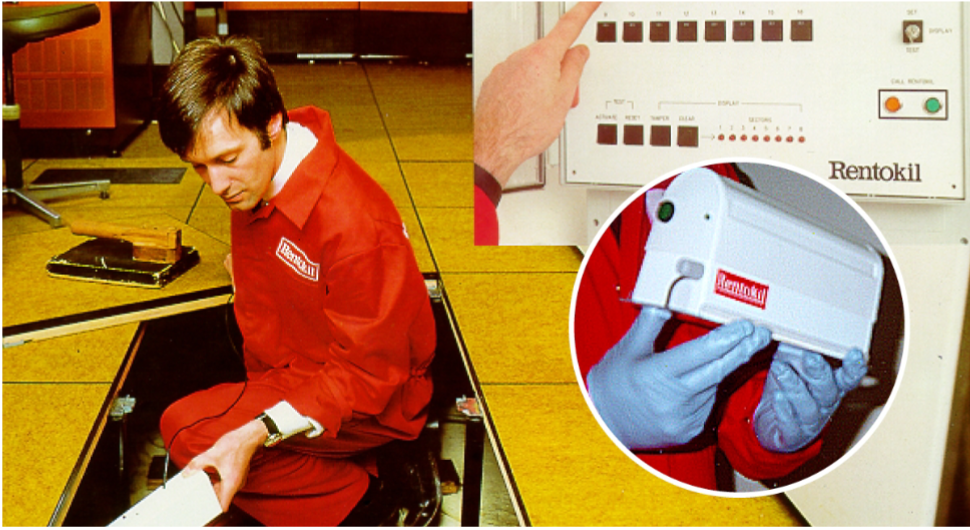
Benjamin Franklin is often credited with demonstrating the principles of electricity in 1752. Not long after, inventors began finding innovative ways to harness this new form of energy, and it eventually found its place in pest control as well.
The concept of using electricity to manage pests emerged as electrical power became more widely available in the late 19th and early 20th centuries. However, it wasn’t until 2000 that Bob Noe patented a modern electric mousetrap.
These traps work by delivering a powerful electric shock to rodents when they come into contact with two metal electrodes, ensuring a quick and lethal result. Electric mousetraps can be used in homes for single catches or in commercial settings for multiple-catch protection. Today, there are many electric trap models on the market – while some are highly effective, others fail to meet expectations.
Live-catch mouse traps
Historical texts from the Middle Ages, such as those by Mascall, mention the use of “deadfall” traps. These early traps worked by dropping a lid or weight when triggered, and they are considered among the first live-capture designs.
In 1870, W.K. Bachman patented what is thought to be one of the earliest purpose-built live-capture mousetraps. Live traps are considered a more humane method of rodent control, as they allow mice to be caught without injury and then released elsewhere, away from homes or businesses.
Many modern live-capture traps include viewing windows, making it easy to check if a rodent has been caught so it can be released promptly and unharmed.
The enduring legacy of the ‘Little Nipper’
While the “Little Nipper” inspired the development of many other mousetrap designs over the years, its simplicity, reliability, and ease of use have ensured its lasting popularity. Even today, the snap trap – especially the iconic “Little Nipper” style – remains one of the most widely used and instantly recognisable types of mousetraps.
Connected mouse traps
The newest advancement in mousetrap technology is the emergence of connected traps, which have transformed pest management. Unlike traditional traps, these smart devices significantly cut down the response time to rodent infestations.
Connected traps rely on sensors, wireless technology, and cloud-based systems to provide real-time monitoring of pest activity. This eliminates the need for physical inspections, as pest control professionals receive instant alerts when a rodent is caught.
These intelligent traps gather important data, such as the timing and location of captures. This data helps identify problem areas, forecast potential infestations, and improve overall pest control tactics.
Rentokil’s research team developed MouseAlert, which after extensive refinement led to the creation of RADAR, the world’s first connected mouse trap. Ongoing innovation has resulted in RADAR X, an enhanced model featuring two trapping chambers to offer businesses double the protection and greater assurance.
Where will mouse traps go next?
Connected traps are just the beginning of what’s possible with connected pest control. As
technology advances, we can expect to see even more sophisticated solutions emerge, and the
humble mouse trap will continue to develop. Find out more about our professional rodent control solutions today.
